
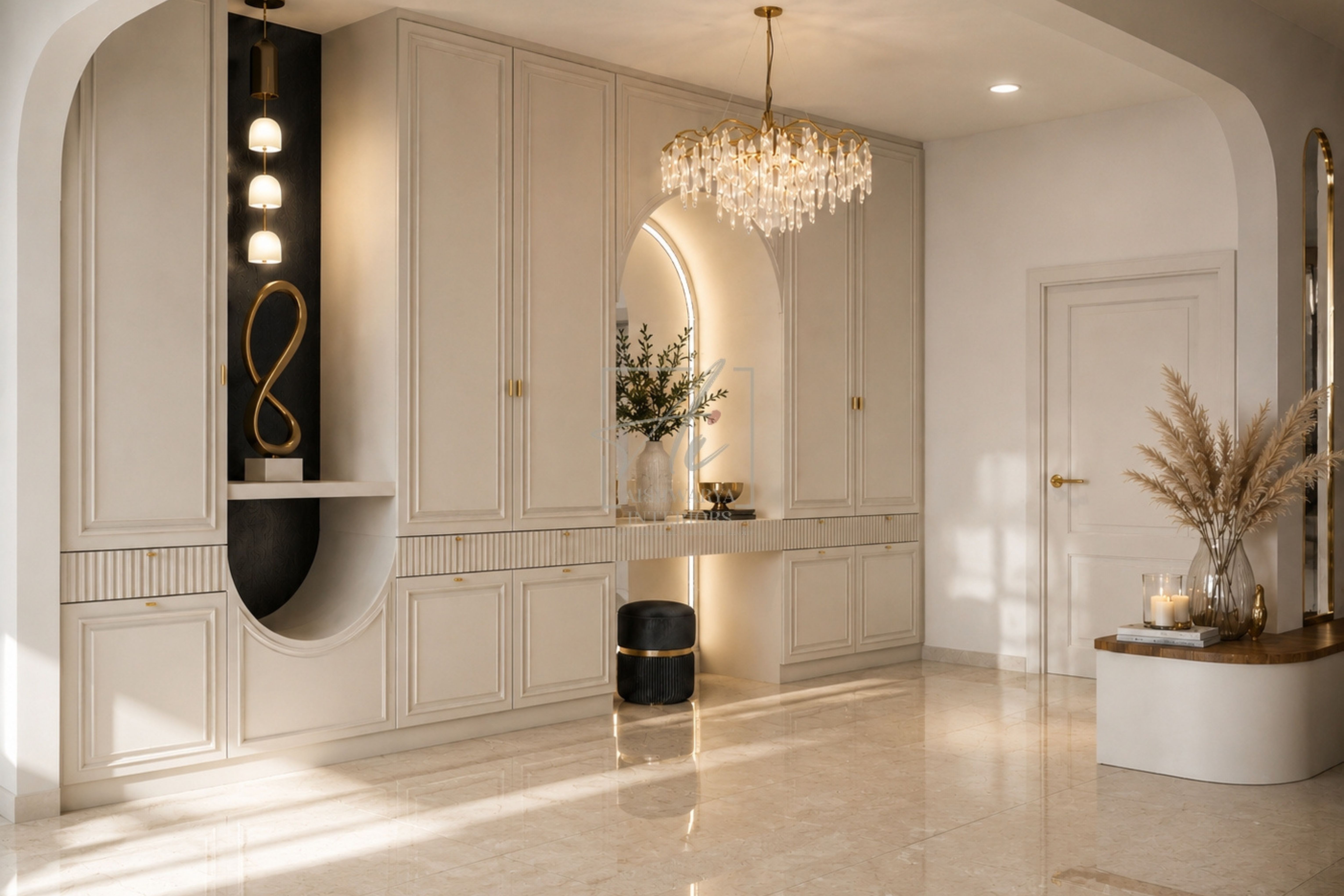
Lighting That Responds to How You Actually Live
For most of interior design’s history, lighting has been a fixed decision — a switch, a fixture, and a single level of brightness that stayed the same whether it was 7 AM or 11 PM. That’s no longer how luxury homes are being designed. Smart lighting has moved from a novelty feature to a genuine design layer, one that responds to the time of day, the activity in a room, and the mood a homeowner wants to create, without anyone needing to think about it consciously.
At Aishwarya Interiors, we’ve spent over two decades designing luxury homes across Bangalore, and smart lighting has become one of the most requested — and most rewarding — additions to recent projects. Done well, it doesn’t feel like technology at all. It simply feels like a home that understands itself.
Why Smart Lighting Belongs in Luxury Interior Design
Lighting has always shaped how a room feels, but smart systems allow that effect to change through the day rather than staying static. A well-designed smart lighting plan does a few specific things that traditional lighting simply can’t:
- Adapts automatically to time of day, activity, or occupancy, rather than requiring manual adjustment
- Creates consistent moods through pre-set scenes, so a room can shift from bright and functional to soft and relaxed with a single command
- Works in harmony with other systems — climate control, motorised shades, and entertainment — rather than functioning in isolation
- Supports wellbeing through lighting that mirrors natural daylight patterns rather than staying at one fixed brightness and colour temperature all day
- Improves energy efficiency, since lights can respond to occupancy and natural light levels rather than running unnecessarily
The technology is in service of the experience — the goal is a home that feels effortless to live in, not one that requires a manual to operate.
Scene-Based Lighting: The Foundation of Smart Design
The most practical starting point for smart lighting in a luxury home is scene-based control — pre-programmed combinations of brightness, colour temperature, and which fixtures are active, triggered by a single command rather than adjusting each light individually.
A few scenes that work particularly well in Indian luxury homes:
Morning — cooler, brighter light that supports alertness and energy as the household wakes up.
Daytime/Work — bright, functional lighting suited to focus, particularly valuable in home offices and kitchens.
Evening/Relax — warm, dimmed lighting across living and dining spaces, shifting the home’s atmosphere as the day winds down.
Entertaining — a brighter, more layered combination across living and dining areas, suited to guests and gatherings.
Movie Night — dimmed ambient lighting paired with accent lighting near a media wall, creating an immersive, cinema-like feel in a living room or home theatre.
Once set up, these scenes remove the need to adjust multiple switches or dimmers individually — a single trigger, whether a wall panel, an app, or a voice command, sets the entire room’s mood at once.
Circadian Lighting: Designing With the Body’s Natural Rhythm
One of the more meaningful developments in smart lighting is circadian lighting — systems that automatically shift colour temperature and brightness across the day to align with natural daylight patterns. Cooler, brighter light in the morning supports alertness and focus, while lighting gradually warms and softens through the afternoon and evening, helping the body wind down naturally by nightfall.
This matters more than it might initially seem. Lighting that stays harshly bright late into the evening can subtly work against rest, while lighting that’s too warm and dim during the day can leave a room feeling sluggish. Circadian lighting removes the guesswork, adjusting quietly in the background so a home’s lighting supports the body’s natural rhythm rather than working against it.
Where Smart Lighting Makes the Biggest Difference
Living Rooms
Scene-based control shines here — the same room can move from bright and functional during the day to warm and cinematic in the evening, without needing multiple separate fixtures manually adjusted one by one.
Bedrooms
Gentle, gradual dimming in the evening and a soft wake-up sequence in the morning can meaningfully improve how a bedroom feels to live in, far beyond what a standard dimmer switch offers.
Kitchens
Bright, focused task lighting during meal preparation can automatically shift to a softer ambient setting once cooking is done, supporting both function and atmosphere without separate switches for each need.
Home Theatres
Smart lighting paired with entertainment systems allows a single command to dim the room, adjust accent lighting, and set the mood for a film — one of the most popular smart lighting use cases in larger luxury homes.
Outdoor & Terrace Spaces
Motion-responsive and scheduled outdoor lighting adds both convenience and security, while scene-based control lets gardens and terraces shift from functional evening lighting to a warmer, more atmospheric setting for entertaining.
Integration: Lighting as Part of a Larger System
The most sophisticated smart lighting setups don’t operate alone — they work alongside motorised shades, climate control, and entertainment systems as part of one coordinated home experience. A single “arriving home” trigger, for instance, might bring up entry lighting, adjust the room temperature, and open shades, all without separate individual commands.
This kind of integration is where smart lighting moves from a convenient feature to a genuine part of how a luxury home functions day to day.
Designing for Simplicity, Not Complexity
A common misconception is that smart lighting means more switches, more apps, and more things to manage. In well-designed luxury homes, the opposite is true — the best smart lighting systems are the ones homeowners barely think about, because the automation handles the everyday adjustments quietly in the background. The technology should disappear into the experience, not sit at the centre of it.
This is an important design principle to hold onto: smart lighting works best when it’s planned early, alongside the rest of the interior, rather than added as an afterthought once the design is finalised. Wiring, fixture placement, and scene logic all need to be considered as part of the overall lighting plan — not bolted on separately.
Common Mistakes With Smart Lighting
A few patterns show up repeatedly in homes where smart lighting hasn’t been planned well. Installing smart bulbs without a broader scene or automation strategy is one of the most common — it adds app control without actually simplifying daily life. Overcomplicating the system with too many manual settings, rather than a handful of well-designed scenes, is another. And treating smart lighting as a standalone technology decision, disconnected from the rest of the interior design, often results in a home that feels technologically advanced but visually disjointed.
Bringing It All Together
Smart lighting, at its best, doesn’t announce itself. It simply makes a home feel more attuned to the people living in it — brighter when it should be, softer when it should be, and effortless to control either way. That kind of thoughtful, well-integrated design is exactly what we bring to every project at Aishwarya Interiors — award-winning luxury interiors across Bangalore, where technology and craftsmanship work together, not compete for attention.
Planning a luxury home with smart lighting in Bangalore? Contact Aishwarya Interiors for a personalised design consultation.